Practice Alone. Make Music Together.
Practise Alone. Make Music Together.
Why good musical collaboration begins long before two musicians sit down together.
Learning the piano can be a lonely business. Hours spent practising scales, correcting rhythms, untangling difficult passages and repeating the same few bars until they finally begin to behave.
Alone.
Yet some of the most rewarding moments in music happen when we share it with someone else. And strangely enough, those solitary hours are precisely what prepare us for them.
Twenty years of friendship. Our first duet.
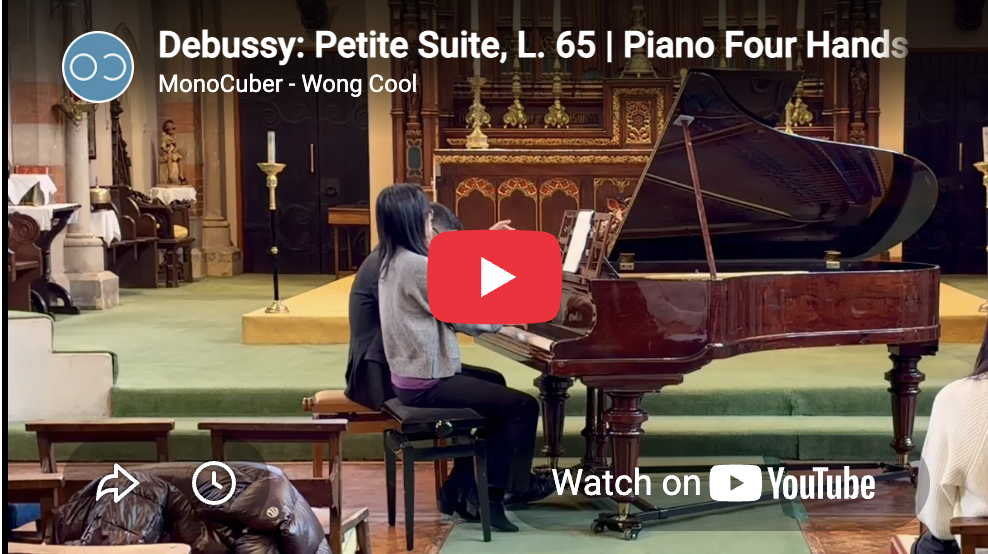
At our charity concert in London on 15 November, I performed Debussy's Petite Suite with my friend Debra Wong. We'd known each other for over twenty years, but had never played together.
It was also my first public piano duet since I was twelve. A rather long interval between performances, even by my standards.
Playing four hands on one piano is an interesting experience. Two people, one keyboard, four hands and occasionally rather different ideas about exactly when the next note should arrive.
There's nowhere to hide. Or is there?
When things don't quite go together
During the second movement, Cortège, some of our chords didn't land quite together, particularly where rubato gave the music a little more freedom.
Not ideal.
But we didn't stop, nor did we try to force everything back into mechanical precision. Instead, we made small adjustments. Some chords were gently spread, almost like a glissando, allowing the texture to remain natural while we found our way back together. With the melody leading, the accompanying parts had a little room to reorganise themselves without interrupting the musical flow.
Most listeners probably wouldn't have noticed.
This wasn't a clever trick we had planned in advance. Nor is spreading chords an appropriate solution to every ensemble problem. It worked in those particular moments because we understood the musical texture, knew which line was leading and shared a sense of where the phrase needed to go.
The important thing wasn't that we could disguise a mistake. It was that we knew enough about the music to recover without losing its direction.
And that brings me to something I care about deeply as a piano teacher.
Why I insist on the details
Students sometimes wonder why teachers make such a fuss about apparently small things. A slightly uneven rhythm. An inner voice that hasn't been brought out. An articulation that doesn't quite match the phrase. A harmony that hasn't been properly understood.
Surely getting through the piece is the main thing?
Not quite.
When you play alone, you can sometimes get away with a vague understanding of what you're doing. You may even produce a reasonably convincing performance. But add another musician, and those gaps become much harder to ignore.
Your rhythm is now something another person depends on. Your phrasing affects their breathing. Your understanding of the harmony influences where they expect the music to move next. And your attention to detail determines how clearly you can communicate your intentions.
This is why I believe musical theory and structure deserve a central place in instrumental learning. Not simply because examinations require them.
Two musicians may have grown up in different countries, studied with different teachers and developed quite different musical instincts. They don't have to agree on every interpretative choice, but they need a common understanding of the piece.
Where is the phrase heading? Which voice matters most? What creates tension, and what brings release?
These questions give musicians a shared musical language.
Theory helps us understand the music. Interpretation gives that understanding a purpose. Careful preparation allows us to communicate it.
Without those foundations, collaboration can become little more than two people trying to stay together.
The freedom to listen
There's a curious paradox here. The more securely you know your own part, the less attention you need to spend worrying about it.
That leaves room for something far more interesting.
Listening.
Not just checking whether your partner is keeping up, but noticing the shape of their phrase, responding to a change in colour, anticipating a breath or allowing their interpretation to influence yours.
Sometimes you lead, sometimes you follow, and sometimes your partner comes up with a better idea than the one you arrived with. That's one of the pleasures of making music together: discovering something neither musician would have created alone.
But it only works when both have something solid to contribute. Friendship and a shared musical background certainly help, as Debra and I discovered, but neither can replace knowing your part, understanding the music and being ready to make decisions in the moment.
Getting back to the same story
Looking back, I don't find the imperfectly coordinated chords particularly troubling. Live performance is full of small uncertainties, and ours was no exception.
What interested me was how naturally we found our way back.
We weren't trying to make every note sound exactly as rehearsed at all costs. We were trying to remain faithful to Debussy's music and to the interpretation we had developed together. That meant knowing what could be adjusted momentarily, and what needed to remain intact.
The melodic direction. The character of the movement. The balance between the voices. The larger musical journey.
We might have differed slightly in timing, but we hadn't lost sight of the same destination.
Good collaboration isn't about never losing your footing. It's about understanding the music well enough to find it again, together.
Back to the practice room
So, if you're learning the piano, why should you care about all those little details your teacher keeps reminding you about?
Because one day, you might be playing with someone else.
When you know your notes, keep a steady rhythm and understand how the music works, you don't have to spend all your attention worrying about your own playing. You can listen to your partner, enjoy the music together and help each other when something goes wrong.
That's when practising becomes something more than getting ready for the next lesson or exam.
Practising alone is important.
But the real reward is being able to share your music with others.
Watch the performance
Claude Debussy – Petite Suite, L.65 (Piano Four Hands)
Debra Wong and Sheungyuen Lee
From Darkness to Light charity recital
Church of the Holy Innocents, Hammersmith, London
15 November 2026