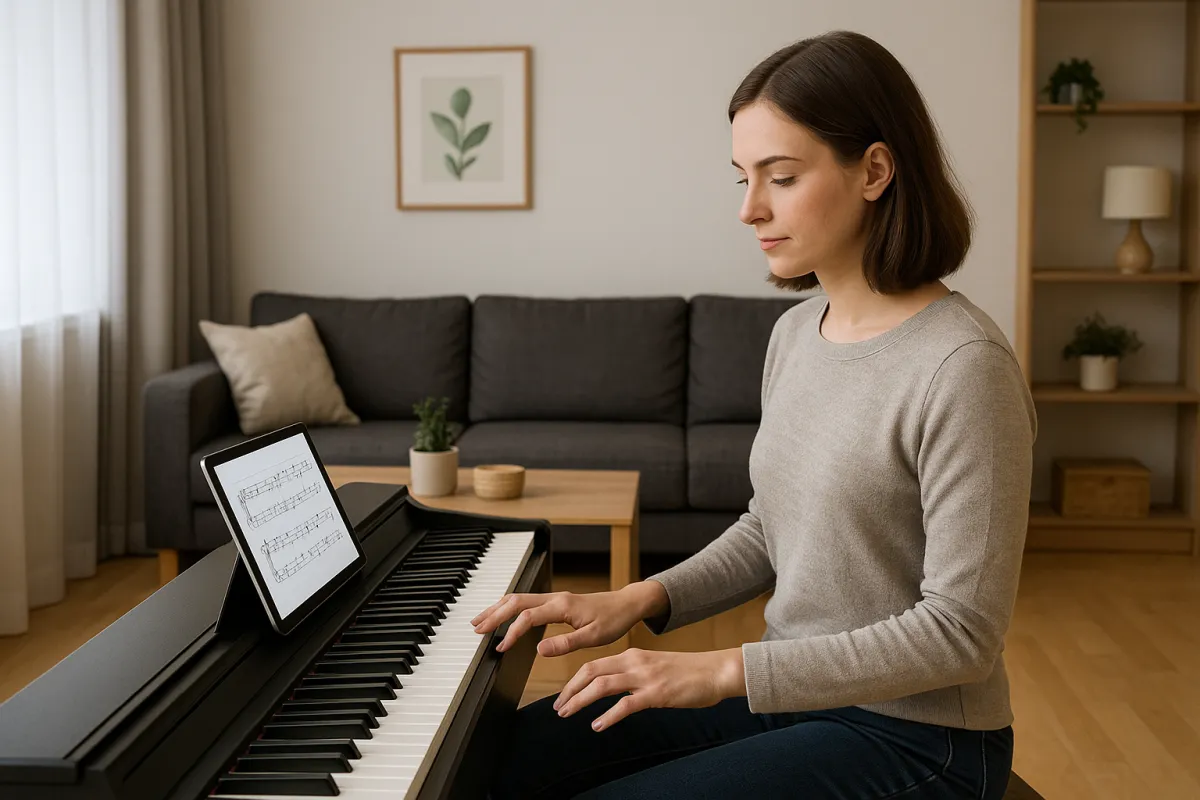
Can I really learn piano as an adult
🎹 “Can I Really Learn Piano as an Adult? Or Is It a Childhood Dream I Missed Forever?” Absolutely Not.

It usually starts with a sigh.
“I wish I learned piano as a kid…”
And it ends with a shrug.
“But I guess it’s too late now.”
Let’s stop right there. Because if you’re reading this, you’re probably not here to give up — you’re here to find out. You’re curious, maybe hesitant, but you haven’t ruled it out entirely. And that means something powerful: the music in you hasn’t given up on itself.
Whether you’re in your 30s, 50s, or even 70s, I’m here to tell you — with a mix of realism, wit, and 24 years of public service grit — you absolutely can start learning the piano as an adult. And not just learning it… enjoying it, progressing in it, and making it part of a richer, more expressive version of your life.
I’ve seen it again and again — with students who’ve waited decades to finally touch those keys. Some had doubts. Others had trauma (flashbacks of failed lessons or strict teachers). But all of them found something unexpected when they gave it a proper go.
Let me walk you through three of the most common myths that hold adults back — and show you why none of them deserve the final say.
⸻
🎯 “Music Is a Language — And Adults Learn Languages Differently, Not Worse.”
Here’s the first mental block:
“Kids pick things up faster.”
True? In some ways.
But here’s the twist — adults are actually more efficient learners in many cases, especially when it comes to music.
You see, children often learn through imitation and repetition — without knowing why things work. Adults, on the other hand, crave understanding. We want patterns. We want logic. We want metaphors that make sense.
And that’s exactly how I teach.
Take the keyboard, for instance. At first glance, it might look like a shiny row of black-and-white confusion. But once I introduce it as a natural landscape, students start to see it differently.
Imagine each note as a friendly animal in a familiar habitat.
• C for Cat, curled up right before the two black keys.
• D for Dog, sniffing between the two trees.
• E for Elephant, walking past them.
Then the next cluster begins — F for Frog, G for Giraffe, and so on.
Suddenly, you’re not memorising. You’re recognising.
You’re exploring. You’re walking through a musical landscape that makes intuitive sense.
That’s adult learning done right — using mental anchors, story, and structure to decode something unfamiliar.
⸻
👟 “No Ballet Slippers Required: Piano Can Start from Where You Are, As You Are.”
Let’s clear up another myth:
“I don’t have the right background.”
You don’t need to have grown up in a musical household.
You don’t need to own a grand piano.
You don’t need a special certificate, a conservatory audition, or ballet slippers (unless that’s your thing).
What you do need is simple:
• A keyboard (even a modest 61-key digital piano is a great start),
• A bit of time (even 15 minutes a day adds up),
• And a mindset that says, “I’m willing to sound bad before I sound good.”
Because that’s what true beginnership looks like — not perfectionism, but curiosity.
Not “I need to impress someone,” but “I want to surprise myself.”
One of my adult students — a civil engineer in his late 40s — came to me after years of saying he was “tone-deaf.”
Today, he plays Chopin waltzes by memory. Slowly, imperfectly, and with the kind of sincerity that makes people stop in their tracks.
The idea that music belongs only to prodigies or children? That’s outdated — and frankly, a bit snobbish.
⸻
🌱 “From Self-Doubt to Self-Discovery — Why Adult Beginners Often Succeed Faster Than Kids.”
Here’s a secret that no one tells you:
Adults often make faster, deeper progress than children.
Why?
Because we:
• Show up on time (usually).
• Ask intelligent questions.
• Reflect on mistakes with purpose.
• Know how to commit weekly.
• Understand that growth is uncomfortable — and lean into it.
When you’ve lived a life, built a career, survived difficult days — you don’t take small progress for granted. You cherish it. That’s something kids rarely grasp.
And there’s more: adults are often learning piano for themselves.
Not because a parent is forcing them.
Not because they’re aiming for a grade.
But because they want to feel something again. To reconnect with creativity. To claim a slice of their week that belongs purely to them.
That inner fire? That’s where real learning happens. Not in perfect scales, but in raw commitment.
I’ve seen grown adults cry at the piano — not out of frustration, but out of relief. Because finally, they’ve stopped denying themselves something they’ve wanted for years.
⸻
🎬 Conclusion: You’re Not Too Old. You’re Just on Time.
If you’ve been wondering whether it’s “too late” to learn piano… let me flip that completely:
This might be the perfect time.
You’ve lived. You’ve struggled. You’ve shown resilience.
Now, you’re ready to learn something beautiful — not because you have to, but because you choose to.
Your hands might not be as nimble as a 10-year-old’s.
Your schedule might be chaotic.
Your first few songs might sound clumsy.
But I promise you this:
The first time you play something recognisable, something real — even just “Twinkle Twinkle” — you’ll feel something extraordinary.
And you’ll wonder why you waited so long.