Why Beethoven’s Overlooked Finale Stayed With Me for Four Years
Why Beethoven’s Overlooked Finale Stayed With Me for Four Years
When people mention Beethoven’s Waldstein Sonata, they almost always think of the opening movement.
It is one of the composer’s most recognisable creations—heroic, energetic and deservedly celebrated.
I’ve always been drawn instead to the finale.
Not because it is “better”. It isn’t a competition. Rather, I’ve always felt that the third movement deserves far more attention than it usually receives. It quietly sits behind one of Beethoven’s greatest openings, asking for a different kind of appreciation.
I first began learning it in 2022.
Since then, excerpts have appeared on public pianos in Japan and Thailand whenever an opportunity arose. Most of the real work, however, happened back in the UK. Over the years I made several serious attempts to record it, but each one ended in the same way: after listening back, I quietly deleted the recording.
Not because they were disasters.
Simply because they never felt secure enough.
Eventually, during a recent visit to Singapore, I booked a few hours at Avocado Piano Studio in Fort Canning and tried again.
This recording is still unmistakably amateurish. There are countless details I already want to improve. But for the first time, the performance stayed together from beginning to end without constantly feeling as though it might fall apart around the next corner.
For this particular movement, that felt like genuine progress.
Memorising Is Only the Beginning
Working on this piece reinforced something I have believed for many years.
Slow practice does not belong only to the early stages of learning.
Many pianists associate slow practice with reading the notes. Once the piece has been memorised and can be played at concert speed, they naturally spend most of their time practising at that speed.
I have increasingly found myself doing the opposite.
The more familiar I become with a piece, the more often I deliberately slow it down again.
Not because I have forgotten it.
Because I don’t want to forget what makes it convincing.
TheWaldsteinfinale provides a wonderful example.
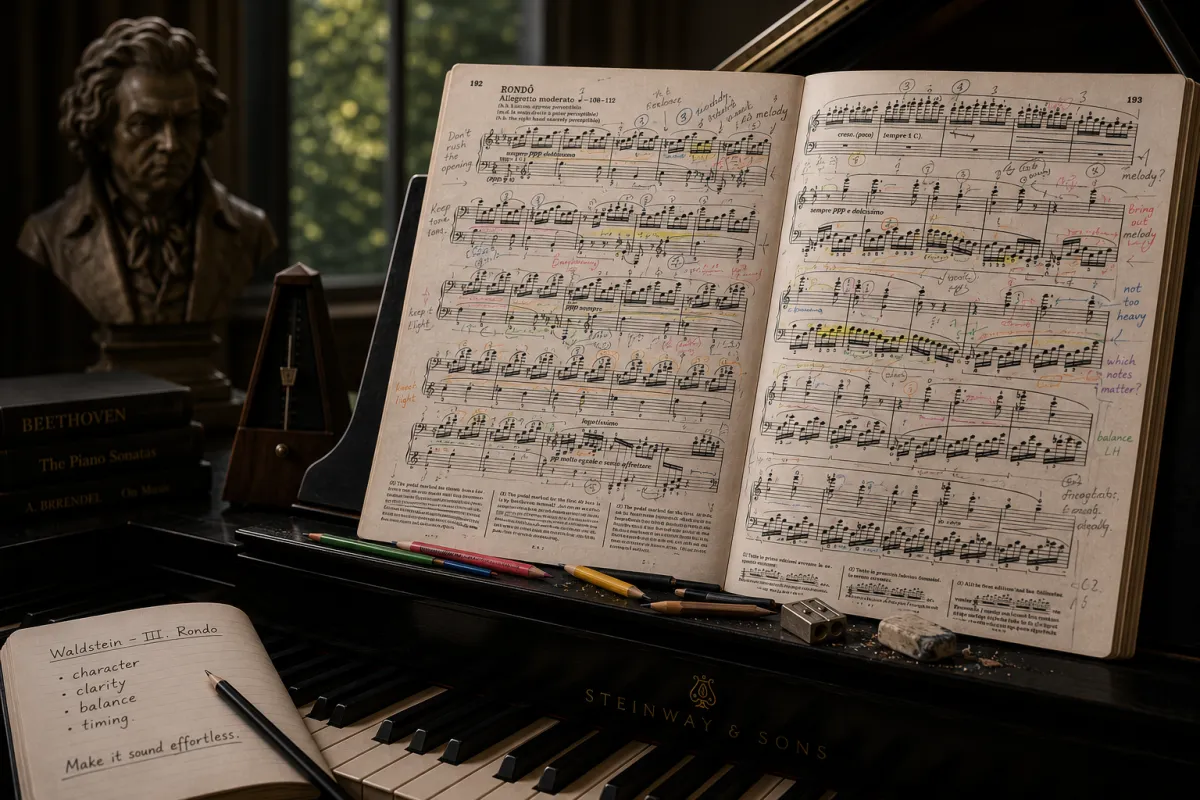
Immediately after each return of the Rondo theme, Beethoven writes extended passages of flowing triplet semiquavers. At first glance they appear to be variations of the same idea.
They are anything but.
Each appearance presents a completely different musical problem.
The first asks for control.
Beneath the glittering surface lies a melodic line that must continue to sing. At full speed it is remarkably easy to produce all the notes while quietly losing the music. Slow practice gives me time to listen for the principal voice and shape it consciously instead of hoping it somehow emerges by itself.
The second is almost a conversation—or perhaps even a friendly dance battle—between the two hands. One hand presents its idea, then the other replies. The listener should hear a single uninterrupted musical line, even though responsibility keeps changing hands. This is also where the fingering becomes particularly cramped. Slow practice allows me to experiment with fingerings, coordinate the hand changes, and make those exchanges sound seamless rather than like alternating fragments.
The third occurrence changes character again.
The writing becomes denser, faster and considerably more demanding. At that point, giving every note equal attention is neither possible nor desirable. The real question becomes: which notes actually matter?
Only after identifying the important voices can I begin to shape the music properly, bringing those notes to the foreground while allowing everything else to support them. At the same time, Beethoven asks for rapid changes between strength and delicacy without sacrificing clarity, momentum or intensity.
Those decisions cannot be improvised during performance.
They are built patiently through slow practice.
Restoring Rather Than Relearning
Perhaps that is why I no longer think of slow practice as relearning.
I think of it as restoring.
Playing slowly allows me to check whether the melodic line still speaks clearly, whether the balance between the hands remains convincing, whether the fingering still feels natural, and whether every movement is still intentional rather than merely automatic.
Muscle memory is an extraordinary servant.
It is also a dangerous one.
Left alone for long enough, it quietly smooths away the very details that make a performance musical. Slow practice refreshes those details. It reminds the fingers—and more importantly, the mind—what they are actually trying to achieve.
Listening plays an equally important role.
Throughout these four years I spent many hours listening to outstanding pianists perform this movement. Not to copy them, but to understand how different musicians solved the same problems. Where does the music breathe? Which voice deserves attention? How much freedom is too much? How does one pianist create brilliance while another creates elegance?
Those hours away from the keyboard were not separate from practising.
They were practising.
Playing the piano is never purely a physical activity. I have always felt that at least half of the work happens before the fingers touch the keys.
The hands can only express ideas that the mind already understands.
Four Years Well Spent
Looking back, I don’t really think it took me four years to learn the notes.
It took me four years to begin understanding the movement.
That understanding is still incomplete, and I hope it remains so. Music that reveals everything immediately rarely keeps our company for very long.
TheWaldsteinfinale has continued to reveal something new each time I return to it.
For now, this recording simply marks one point on that journey.
Not a destination.
Just the first version I felt was complete enough to keep.
⸻
🎹Watch the full performance on YouTube:
Beethoven – Waldstein Sonata, Op. 53 (III. Rondo)