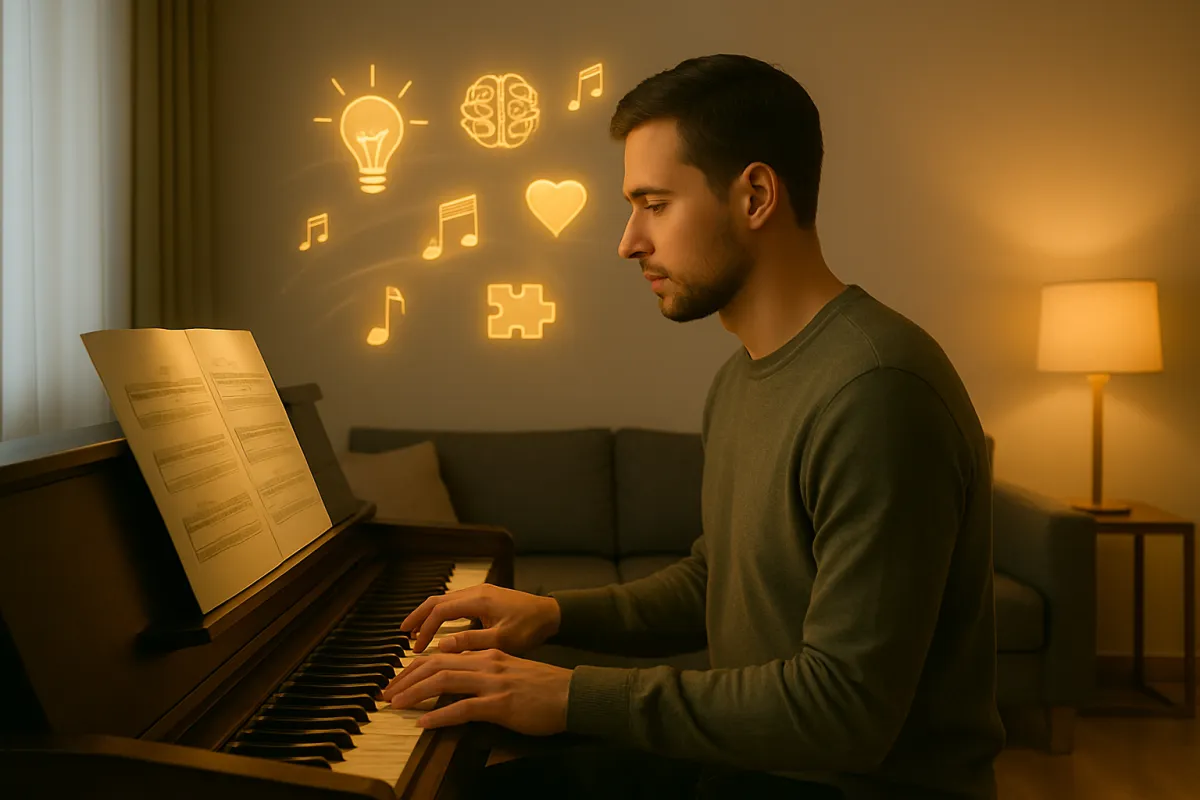
Think Piano Only Improves Music Skills? Here’s How It Boosts Memory, Creativity, and Emotional Intelligence
🧠“Think Piano Only Improves Music Skills? Here’s How It Boosts Memory, Creativity, and Emotional Intelligence”
Let’s get one thing straight: piano doesn’t just make you better at piano.
Sure, you’ll learn scales, arpeggios, and maybe even impress someone at a party with a dramatic run of notes. But the real payoff? It’s what happensoffthe bench. Piano practice quietly strengthens your memory, unlocks your creativity, and even deepens your ability to connect with others.
In short: piano is life training in disguise. Here’s how.
⸻
🧩Memory Muscles You Didn’t Know You Were Training
Ever had to memorise a piece? At first, it feels impossible — too many notes, too many pages. But slowly, your brain adapts.
You start remembering patterns instead of single notes. Muscle memory kicks in. You hear the music in your head even when you’re away from the keys.
That’s not just “music memory.” That’s your brain building new neural pathways. And those pathways spill into daily life — remembering names, recalling details at work, staying sharper as you age.
It’s no wonder researchers link piano learning with improved memory and cognitive resilience. Piano isn’t just notes — it’s mental gym.
⸻
🎨Creativity Unlocked Through Musical Exploration
Every time you sit down at the piano, you’re making creative decisions:
• Should this phrase be bold or gentle?
• How do you make a piece feel alive, not robotic?
• What happens if you improvise a little?
That creative workout transfers. Piano teaches you to approach problems with flexibility, to think outside rigid boxes. You stop asking,“What’s the one right answer?”and start asking,“What’s possible here?”
It’s no coincidence so many innovators — from scientists to entrepreneurs — also play instruments. Music isn’t a distraction. It’s creativity practice, disguised as fun.
⸻
💞Empathy and Emotional Intelligence From Interpreting Music
Here’s something people often overlook: when you play piano, you’re not just pressing keys. You’re telling a story.
To do that, you have to ask:
• What was the composer feeling?
• How can I express that in sound?
• How might the audience feel when they hear this?
That’s empathy training. It forces you to imagine emotions beyond your own, and to translate them into something others can feel. Over time, this shapes not only your music, but how you listen, communicate, and connect with people.
Piano becomes more than music — it becomes a bridge between inner life and outer world.
⸻
🎬Piano Is a Multiplier, Not Just an Instrument
So the next time someone says,“Why bother learning piano? It’s just music,”you’ll know the truth.
Yes, it’s music. But it’s also sharper memory, freer creativity, and deeper emotional intelligence. Piano practice isn’t wasted time — it’s investment in your brain, your heart, and your imagination.
Play a few notes, and you might just end up becoming a fuller version of yourself.
⸻
💬Next in the series:
“From Solo to Symphony! How Piano Teaches Collaboration and Leadership.”