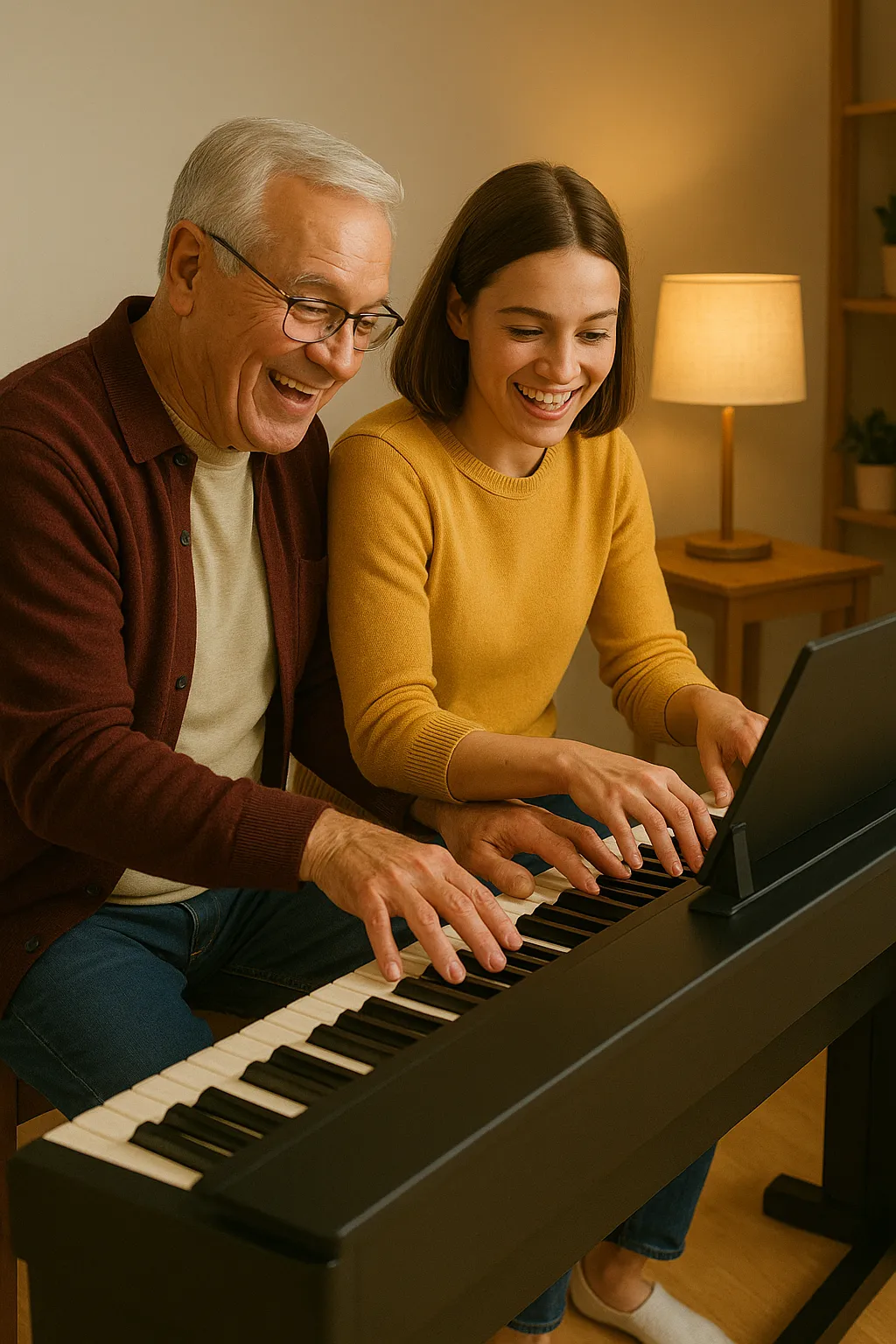
The Smartest Family Hobby! Why (Grand)Parents Should Learn Piano With the Kids—Starting This Month
👨👩👧👦“The Smartest Family Hobby! Why (Grand)Parents Should Learn Piano With the Kids—Starting This Month”
Lessons Beyond the Keyboard
Learning piano is often filed under “something for the children.” Cute recitals, sticker charts, and grandparents in the audience holding phones at improbable angles. But here’s a better idea:move from the audience to the bench. If you’re a parent—or a grandparent—learningwithyour child or teen isn’t indulgent. It’s one of the most powerful investments you can make in your family’s brains, bonds, and daily joy.
Yes, even if you haven’t touched an instrument since school assemblies. Yes, even if you worry about “no talent” or “no time.” And yes, even if the teenager in question currently communicates in shrugs. This isn’t about producing prodigies. It’s about building ashared practicethat sharpens minds, lowers stress, and quietly raises the standard of who we are together.
Below, I’ll show you why intergenerational learning works so well—and exactly how to start, step by realistic step.
⸻
🧠“Two Brains, One Bench”: Cognitive Gains for Every Age
Let’s start with the brain. Piano is famously good for it—for children, adults, and especially older adults. It engages memory, attention, coordination, problem-solving, and emotional regulation. But something special happens when you combine ages at one instrument.
For kids/teens
• They see learning modeled in real time. Not lectures—example.
• Their “why bother?” melts when they watch you struggle, laugh, and improve.
• Executive functions sharpen faster: planning (“Who starts?”), time management (“Ten minutes before dinner”), and reflection (“What went better today?”).
For parents
• Piano practice is mental cross-training. It interrupts the loop of emails, errands, and invisible load.
• You rebuild a beginner’s mindset—vital for staying adaptablein work and life.
• You gain empathy for your child’s effort. Scales stop being nag-worthy; they becometeamwork.
For grandparents
• Learning piano iscognitive protection. It stimulates new neural pathways and supports memory health.
• It offers structure and purpose, wrapped in music and companionship.
• You move from spectator toco-adventurerin your grandchild’s week—no device required.
And there’s a lovely side effect:mutual humility.Children discover adults don’t know everything; adults rediscover that somethings take time—and that’s perfectly fine.
⸻
🫶“Bonding in the Real World”: A Routine That Outlasts Phases and Fads
Teenagers change music tastes weekly. Life seasons shift. But a10–20 minute piano routinecan outlast the algorithms. Here’s why the shared habit works:
1) It converts time together into progress together.
Watching TV is time together. Practising a duet istime + growth. You leave the bench better than you sat down.
2) It defuses conflict by externalising the goal.
Instead of “parent vs child,” it’s “us vs this tricky bar 17.” You stand shoulder to shoulder against a shared puzzle.
3) It creates low-stakes, daily celebration.
A neat cadence. A clean scale. A left-hand pattern finally landing.Micro-winsare the glue of good relationships.
4) It gives each person a turn to lead.
Some days the teen reads faster; some days the grandparent’s rhythm is steadier. Leadership rotates without speeches.
5) It builds family culture.
“After homework and tea, ten minutes at the piano.” That’s not just a schedule—it’s an identity:we are people who practise.
And when holidays or big emotions roll in, the piano becomes amood dial—stormy chords to vent, gentle pieces to exhale, upbeat rhythms to reset the room.
⸻
🛠“Start Where You Are”: A Four-Week Family Plan (That Actually Fits Real Life)
No perfection. No hour-long marathons. Just aclear, flexible scaffoldyou can adapt. Choose a digital piano with weighted keys (affordable, reliable) or a well-maintained acoustic. Then try this:
Week 1 — Set the Bench, Not the Bar
Goal:build the routine, not the repertoire.
• 5–10 minutes, 5 daysthis week. That’s it.
• Learn the keyboard map together. Use mnemonics, humour, even your own “animal landscape.”
• Agree “who starts” each day. (Monday = child, Tuesday = parent, etc.)
• Finish every session with awin: one clean bar, one steady pattern, one shared laugh.
Week 2 — One Tune, Two Roles
Goal:make something recognisable—slowly.
• Pickone simple tune(“Ode to Joy,” “Twinkle,” a favourite theme).
• Split parts: melody (right hand) and drone/bass (left hand). Swap roles daily.
• Anchor amicro-ritual: lamp on, metronome gentle, phone face-down.
Week 3 — Four Hands, One Piano
Goal:learn toblend.
• Choose a beginnerduet(four-hand version of your Week-2 tune if possible).
• Practisecount-in and eye contact. Cue each other, not just the page.
• Add afamily mini-recitalon Sunday. Two minutes. Clap anyway.
Week 4 — Tiny Project, Real Pride
Goal:ship something.
• Record a single take (no perfection edits).
• Title it (“Tuesday Evening Waltz, Take 3”).
• Send to grandparents/relatives, or save to a private family album.
• Reflect in one sentence:“Today I learned…”/“Next I’ll try…”
If illness or chaos hits:reduce to2 minutes. Touch a scale, one cadence, close the lid.Consistency beats intensity.
⸻
🧩“What About Friction?”—Real-World Solutions for Common Snags
“No time.”
Make itadjacentto an existing habit: after dinner, before screens; after school, before bath. The key issame time, same place.
“The teen won’t play with me.”
Don’t force the duet. Sit nearby andmirrora tiny element—tap the rhythm, sing the left-hand line, or play the final cadence together. Participation scales up from there.
“Different ability levels.”
Good. That’s the point. Arrange music withlayered difficulty: one part simple and steady, the other slightly busier. Swap parts next day.
“I feel silly as an adult beginner.”
Beautiful. Your child gets a living lesson incourage and patience. Name it: “I’m new at this, too. Let’s be brave together.”
“Practice triggers nagging.”
Offload motivation to theritual, not the person: lamp on, timer set, page open. Start without debate. Celebrate thestart, not the standard.
“Grandparent lives elsewhere.”
Use video calls for aWeekly Family Play-In. One piece in common, 10 minutes total. The point is thetouchpoint, not the tempo.
⸻
🎯Choosing Music and Tools That Help (Not Hinder)
• Repertoire:familiar tunes first (recognition breeds motivation), then very short “pattern pieces” that sound satisfying quickly.
• Tempo:slower than you think; steady > speedy.
• Metronome:friend, not judge—start with quiet clicks or app pulsing lights.
• Apps/Videos:pickonestructured source at a time to avoid overwhelm.
• Notebook:two lines per day:What worked.What’s next.
• Environment:clear the top of the piano; lamp; pencil on the stand; timer within reach.
If you study with a teacher (hello 👋), ask forfamily-friendly arrangementsand afour-week micro-plan. A good teacher will design the path so your motivation doesn’t have to carry the load.
⸻
🪴What You’ll Notice by Month Three
• The room feels calmer after you play.
• The teenager’s rhythm and focus spill into homework.
• The grandparent’s confidence nudges speech, posture, even walking pace.
• “Ten minutes at the piano” becomes ahousehold habit—as normal as brushing teeth.
• You have a handful offamily piecesthat belong to you—Thursday songs, rainy-day songs, victory songs.
No grades required. No audience necessary. Just a bench, a routine, and a quiet pride that sneaks up on everyone.
⸻
🎬Don’t Just Cheer—Join
Being in the audience is lovely, but the real magic ison the bench. If you’re a parent or grandparent, learningwithyour child or teen is one of the most generous—and practical—gifts you can give: shared time, sharper minds, calmer evenings, and memories that will sit in your family for decades.
You don’t need to be “musical.” You need ten minutes, a lamp, and each other.
When you’re ready, the first note is waiting.