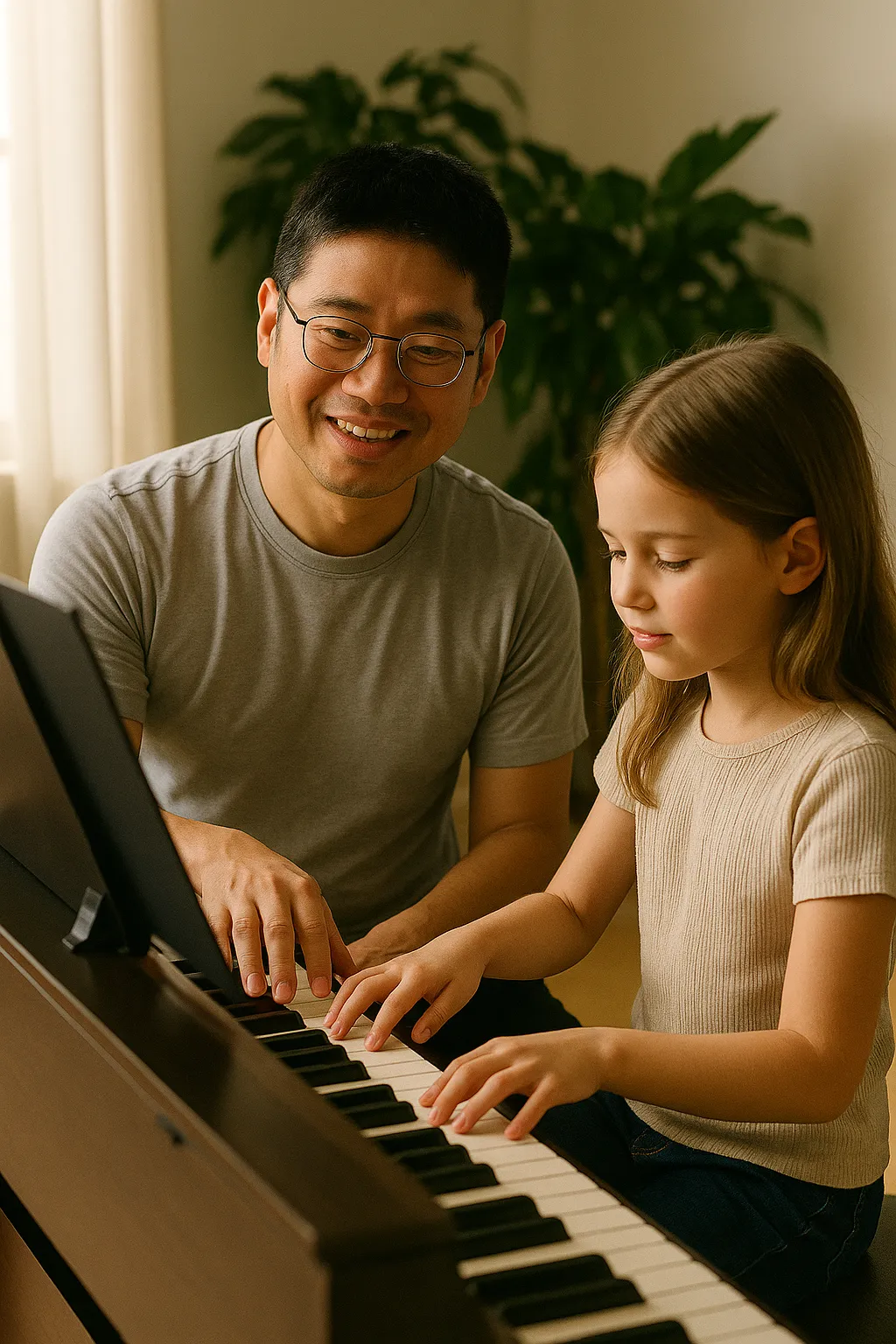
🎹 The Ideal Piano Teacher: Beyond Technique, Toward Life Lessons
🎹The Ideal Piano Teacher: Beyond Technique, Toward Life Lessons
Lessons Beyond the Keyboard
Parents often imagine a piano teacher as someone armed with scales, patience, and a metronome. True enough — but the best teachers do more than train fingers. They cultivatecharacter. They help children discover not only how to make music, but how to listen, focus, persist, and believe in themselves when no one else claps.
Below is what separates a mere instructor from a mentor who quietly changes lives — one lesson, one laugh, one wobbling left hand at a time.
⸻
🎼Technique Is Only Half the Story
A metronome can perfect timing. A teacher perfectstemperament.
Yes, fingering, posture, and rhythm matter. But underneath every well-played piece lies a child learning patience, courage, and curiosity. When a teacher insists on accuracy with warmth, they’re really teaching the child that discipline doesn’t mean pressure — it meanscare for detail.
The great irony? Children who feel safe to make mistakes end up playing more precisely. Because the moment they stop fearing errors, they start hearing themusic.
A good teacher corrects wrong notes.
A great one teaches why a wrong note isn’t the end of the world.
⸻
🫶What Children Remember Is Rarely a Scale
Ask adults what they recall from childhood lessons, and most won’t name the sonata. They’ll recall the teacher who smiled when they finally managed two bars in tempo — or who calmly reset the metronome after a meltdown.
Those small gestures plant the seed ofresilience. A seven-year-old learns: “It’s okay to pause. I can try again.” That mindset travels everywhere — into school exams, friendships, and later, careers.
Parents often underestimate how much authority a teacher’s tone carries. The difference between “wrong again” and “let’s try it slower” can decide whether a child learns to associate improvement with shame or discovery.
The best teachers train ear, hand, andheartin the same phrase.
⸻
😄Humour, Empathy and Authority in Perfect Balance
A piano lesson is half psychology, half performance art. The child comes in restless, shy, or overconfident; the teacher must instantly read the room. Too strict, and curiosity dies. Too lenient, and focus evaporates.
So the best teachers play a subtle game: a wink after a good attempt, mock-serious “bravo” for a stubborn wrong note, then gentle redirection —“I think Beethoven might prefer C-sharp here.”
Humour lowers tension. Empathy rebuilds trust. And authority, when earned rather than enforced, lets a child feel proud to follow.
In that sense, teaching piano is rehearsal for adulthood: every week the child practises responding to feedback, managing frustration, and staying kind under stress.
⸻
🌱The Hidden Curriculum of Great Teaching
Behind every polished performance hides a quiet code:
• Discipline without fear.Practice isn’t punishment — it’s craft.
• Effort before talent.Progress earns applause, not natural flair.
• Respect for silence.The pause between notes teaches presence.
• Joy in sharing.Music is meant to be given, not graded.
These lessons don’t stop at Grade 8; they follow the child into meetings, projects, and relationships. When you see your child persevere gently with a tricky phrase instead of slamming the lid — that’s piano transforming life, invisibly.
⸻
🎬When Technique Meets Humanity
Every great musician once had a teacher who saw more than their posture — who noticed the shy courage behind a single note played right after failure.
That’s what we strive for at Wong Cool Piano Lessons: lessons that build both skilland self. Because music is temporary — but the person playing it lasts.
So, next time you watch your child at the piano, remember: the music they’re making is only half what they’re learning.